
Marine Life of the Red Sea – Explore the Underwater World with UCPA Egypt
The Red Sea is one of the most fascinating marine environments in the world. Beneath its clear blue waters is an extraordinary underwater ecosystem filled with coral reefs, colourful reef fish, sea turtles, rays, moray eels and many other forms of marine life.
For anyone interested in scuba diving, Diving in Hurghada offers an opportunity to discover this underwater world directly. With its location on the Red Sea coast, Hurghada provides access to a wide variety of marine environments and diving experiences.
At UCPA Egypt, we invite divers to Explore the Red Sea and discover the incredible diversity of life beneath the surface.
Whether you are a first-time diver, an Open Water certified diver, an experienced diver, or someone looking for PADI or SSI diving experiences, the marine life of the Red Sea can make every dive different.
Why Is the Red Sea So Rich in Marine Life?
The Red Sea has a unique geographical and environmental setting.
It is a relatively narrow sea connected to the Indian Ocean through the Gulf of Aden and the Bab-el-Mandeb Strait. Its warm waters, extensive coral reefs and distinctive marine environment have helped create habitats for a remarkable variety of species.
The Red Sea contains extensive coral reef systems that provide shelter, feeding areas and breeding grounds for many marine organisms.
For divers, this means that a seemingly simple reef can actually contain an entire ecosystem.
A coral formation may provide shelter for small reef fish.
A sandy area may be used by rays.
A rocky section may hide moray eels.
And above the reef, schools of fish can move constantly through the water.
This is what makes Red Sea Diving so fascinating.
Every time you enter the water with UCPA Egypt, you can discover something different.
Coral Reefs – The Heart of Red Sea Diving
Coral reefs are among the most important parts of the Red Sea ecosystem.
They are not simply beautiful underwater scenery.
A healthy coral reef is a complex living environment that supports numerous species.
Hard corals create structures that provide shelter and surfaces for other organisms. Soft corals add movement and colour to the reef, especially when currents pass through them.
During Diving in Hurghada, divers can observe different coral formations depending on the location and conditions.
You may see large coral structures rising from the seabed.
You may find branching corals surrounded by small fish.
You may discover colourful soft corals moving gently with the current.
For underwater photographers, coral reefs provide endless subjects.
For beginners, they provide an immediate visual introduction to the underwater world.
For experienced divers, they reveal more details every time you return.
At UCPA Egypt, exploring these reefs is an important part of the Red Sea diving experience.
Reef Fish of the Red Sea
One of the first things many people notice when they begin Hurghada Diving is the number of fish around the reef.
Some species are small and live close to coral formations.
Others travel in large schools.
Some remain close to the seabed, while others move through the water column.
The variety of colours, shapes and behaviours makes reef fish one of the highlights of Red Sea Diving.
Butterflyfish
Butterflyfish are among the most recognisable reef fish.
Their bright colours and distinctive patterns make them easy to notice while diving.
They are often associated with coral reefs and can sometimes be seen moving around coral formations in pairs or small groups.
For photographers and divers, butterflyfish can be an especially attractive subject.
Angelfish
Angelfish are another beautiful group of reef fish.
They are known for their striking colours and patterns.
Seeing an angelfish moving slowly between coral formations is one of those small moments that can make a dive memorable.
Surgeonfish
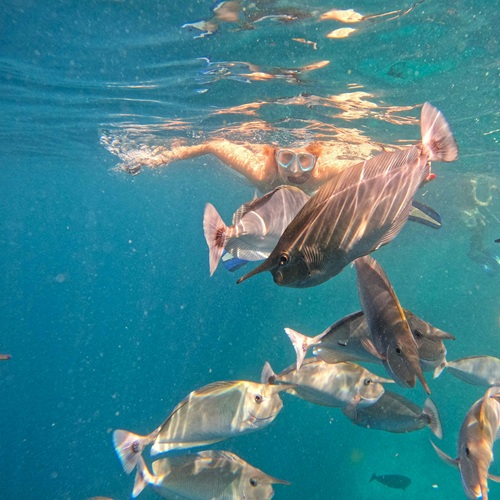
Surgeonfish are often seen moving around reefs and feeding on algae.
They can sometimes gather in groups, creating impressive scenes for divers.
Their streamlined bodies and distinctive markings make them easy to recognise.
Parrotfish
Parrotfish are especially important to coral reef ecosystems because they feed on algae and contribute to the health and development of reef environments.
They can often be heard or seen feeding around coral structures.
During Diving in Hurghada, watching parrotfish move across the reef can be a fascinating part of the dive.
Clownfish
Clownfish are among the most famous fish in the world.
Their relationship with sea anemones makes them particularly interesting to observe.
A clownfish may remain close to its anemone, moving in and out of the tentacles.
For many beginners discovering Red Sea Diving, finding a clownfish is one of the memorable moments of their first underwater experiences.
Moray Eels
Moray eels are another fascinating part of the Red Sea’s marine life.
They are often found with only their head visible from holes or crevices in the reef.
Their appearance can seem intimidating at first, but observing them from a respectful distance allows divers to appreciate their behaviour and role in the ecosystem.
Moray eels are excellent examples of why diving is about more than simply looking at colourful fish.
The more time you spend underwater, the more you begin to notice animals hiding in places you might otherwise overlook.
With UCPA Egypt, divers can learn to observe the reef carefully and appreciate these smaller details.
Sea Turtles
Sea turtles are among the most exciting animals a diver can encounter in the Red Sea.
Seeing a turtle swimming calmly through the water can be an unforgettable experience.
Turtles may be encountered around reefs and other marine environments where they feed or move through the area.
When a turtle appears during a dive, divers are encouraged to remain calm, maintain an appropriate distance and allow the animal to continue its natural behaviour.
For many visitors, a sea turtle encounter becomes one of their favourite memories of Diving in Hurghada.
Rays of the Red Sea
Rays are another fascinating group of animals found in Red Sea waters.
They can often be associated with sandy or shallow areas, depending on the species.
Their graceful movement through the water makes them particularly enjoyable to watch.
Divers may encounter different types of rays, and each encounter can be different.
Some rays spend time close to the seabed.
Others move through the water with powerful but elegant movements.
During Hurghada Diving, keeping an eye on the sandy areas around the reef can sometimes reveal animals that are easy to miss when you only look at the coral.
Eagle Rays
Eagle rays are particularly impressive because of their distinctive shape and powerful swimming style.
Unlike many reef fish, eagle rays can cover considerable distances while moving through open water.
Seeing one during a dive can be a spectacular experience.
For divers exploring the Red Sea with UCPA Egypt, encounters with larger marine animals are among the moments that can make a diving trip unforgettable.
Dolphins
Dolphins are among the most famous marine animals in the Red Sea.
Encounters with dolphins can happen in different circumstances, particularly during boat trips and in areas where dolphins are present.
Seeing dolphins in their natural environment is very different from seeing them in captivity.
Responsible diving means observing marine animals without attempting to chase, touch or disturb them.
The best wildlife encounters happen when divers allow animals to behave naturally.
This is an important part of responsible Red Sea Diving.
Lionfish
Lionfish are visually spectacular.
Their long fins and distinctive patterns make them easy to recognise.
They are often associated with reef environments and can sometimes be seen hovering close to coral structures.
Because lionfish have venomous spines, divers should never attempt to touch them.
Observing marine life from a safe distance is one of the fundamental principles of responsible diving.
At UCPA Egypt, we encourage divers to appreciate marine life without interfering with it.
Triggerfish
Triggerfish are another interesting group of Red Sea reef fish.
They have strong bodies and distinctive shapes, and some species can become territorial, particularly around nesting areas.
This is another reason why divers should maintain an appropriate distance from marine animals.
The objective of Diving in Hurghada is to observe the underwater environment, not to interfere with it.
Butterflyfish, Bannerfish and Reef Communities
A coral reef is rarely about one species.
The real beauty comes from the interaction between many different organisms.
You might see butterflyfish moving around coral.
A school of smaller fish may pass overhead.
A moray eel may remain hidden inside the reef.
A parrotfish may feed nearby.
And a ray may move across the sandy bottom.
All of these organisms are part of the same underwater community.
This complexity is what makes Explore the Red Sea more than simply a sightseeing experience.
You are entering a living ecosystem.
Small Creatures – The Hidden World
Large animals often attract the most attention.
But some of the most interesting marine life is extremely small.
During Red Sea Diving, divers who slow down and look carefully can discover shrimp, crabs, small gobies, nudibranchs and other tiny organisms.
These animals can be difficult to see at first.
Once you learn where to look, however, they become an entirely new part of the diving experience.
This is one of the reasons experienced divers often say that they never stop discovering new things underwater.
Nudibranchs
Nudibranchs are small marine animals famous among underwater photographers and macro-diving enthusiasts.
They can have incredible colours and shapes despite their small size.
Finding one requires patience and careful observation.
A diver who moves quickly across the reef might never notice them.
A diver who slows down and observes carefully may discover a completely different world.
Shrimp and Crabs
Small crustaceans such as shrimp and crabs are also part of the reef ecosystem.
Some hide in cracks.
Some live close to anemones.
Others move across the reef searching for food.
Their small size makes them easy to overlook.
This is why good buoyancy control and careful observation are important parts of enjoying marine life.
Night Diving and Marine Life
The underwater environment can change dramatically after sunset.
Night diving reveals behaviours and animals that divers may not normally see during the day.
Some marine creatures become more active.
Others hide.
Colours can appear very different under diving lights.
A familiar reef can suddenly feel like a completely different place.
For experienced divers, night diving can be a fascinating way to Explore the Red Sea from another perspective.
The underwater world does not simply disappear at night.
It changes.
The Importance of Responsible Diving
Enjoying marine life also means protecting it.
Coral reefs are delicate ecosystems.
Divers should avoid touching coral, standing on reefs or disturbing marine animals.
Good buoyancy control is particularly important because it helps divers maintain a comfortable distance from the reef.
Responsible divers also avoid chasing animals, feeding marine life or collecting coral and shells.
At UCPA Egypt, we believe that the best way to experience the Red Sea is to observe it without damaging it.
The goal is to leave the underwater environment as we found it.
Protecting the Coral Reefs of the Red Sea
The future of Red Sea Diving depends on the health of the marine environment.
Coral reefs face environmental pressures around the world, including rising temperatures, pollution, physical damage and changes in marine ecosystems.
Divers can contribute to reef protection through simple actions.
Maintain good buoyancy.
Do not touch coral.
Do not collect marine life.
Avoid unnecessary contact with animals.
Do not leave waste behind.
Respect local environmental regulations.
And encourage other divers to do the same.
Small actions can make a difference when thousands of people visit the same marine environment every year.
Marine Life and Diving Courses
Learning to dive is also learning how to interact with the underwater environment.
During an Open Water course, beginners learn fundamental skills that help them become comfortable underwater.
As divers progress through PADI or SSI training, they can develop greater awareness of their surroundings and improve their ability to control their position in the water.
Good buoyancy is not only useful for the diver.
It is also important for protecting coral reefs.
A diver who can maintain stable buoyancy is less likely to accidentally touch the reef.
This is one reason why diving education and marine conservation are closely connected.
At UCPA Egypt, we want divers to enjoy the Red Sea while developing responsible diving habits.
PADI and SSI Divers Exploring the Red Sea
Whether you follow a PADI or SSI training pathway, the objective is ultimately to become a safe and responsible diver.
Certification is only the beginning.
Experience comes with time in the water.
Every dive teaches you something new.
You learn to read the reef.
You become better at spotting small animals.
You improve your buoyancy.
You become more aware of currents and conditions.
And gradually, you stop simply looking at the underwater environment and start understanding it.
This is what makes returning to UCPA Egypt and continuing your Hurghada Diving experience so rewarding.
Marine Life for Underwater Photographers
The Red Sea is also a fantastic environment for underwater photography.
Wide-angle photographers can capture coral formations, schools of fish and larger marine animals.
Macro photographers can focus on tiny creatures such as nudibranchs, shrimp and small reef fish.
Every reef offers different photographic opportunities.
But underwater photography should always come after responsible diving.
Getting the perfect photograph is never more important than protecting the animal or coral reef.
At UCPA Egypt, the Red Sea itself provides the inspiration.
The photographer simply has to observe, wait and capture the moment without interfering with the environment.
A Different Marine Life Experience on Every Dive
One of the most exciting things about Diving in Hurghada is that no two dives have to feel exactly the same.
The same reef can look different depending on the light, visibility, current and marine life present at the time.
One dive might be dominated by colourful reef fish.
Another might reveal a turtle.
A different dive might be about a large school of fish.
And sometimes the most memorable moment can be something incredibly small, such as a tiny nudibranch hidden among the coral.
This unpredictability is part of what makes Red Sea Diving so addictive.
You never know exactly what you will discover.
Explore the Red Sea with UCPA Egypt
The marine life of the Red Sea is one of the main reasons people travel to Egypt to dive.
From coral reefs and colourful reef fish to turtles, rays, dolphins, moray eels and tiny hidden creatures, the underwater environment around Hurghada offers a remarkable variety of experiences.
With UCPA Egypt, you can discover this world through diving trips, beginner experiences and diving courses.
Whether you are interested in PADI, SSI, Open Water, Advanced or Rescue training, the Red Sea can become part of your diving journey.
And if you are already an experienced diver, UCPA Egypt offers the opportunity to return to the water, explore new areas and continue discovering the marine life of Hurghada.
Discover the Marine Life of Hurghada
If you are planning your next diving holiday, come to Hurghada and Explore the Red Sea.
Discover coral reefs.
Look for colourful reef fish.
Watch turtles move through the water.
Observe rays crossing the seabed.
Search the reef for moray eels.
Look closely for tiny shrimp and nudibranchs.
And take the time to appreciate the underwater environment as a living ecosystem.
UCPA Egypt welcomes divers who want to discover the marine life of the Red Sea in a friendly and responsible diving environment.
Whether you are searching for UCPA Egypt, Diving in Hurghada, Hurghada Diving, Red Sea Diving, Diving Trips Hurghada, PADI Hurghada, or SSI Hurghada, your Red Sea adventure starts beneath the surface.
UCPA Egypt – Explore the Red Sea
Dive deeper. Discover marine life. Explore Hurghada. Experience the Red Sea with UCPA Egypt.

Recent Posts